
Marks of Reflection with THE SEMI-FINALISTS
An interview crafted with each of the semi-finalists from Sky Portrait Artist of the Year Season 12, 2025. After filming the semi-finals I had a lovely chat with each of the artists about their experience on the show. Read on to hear their thoughts and find out more on our exciting upcoming group show in London.
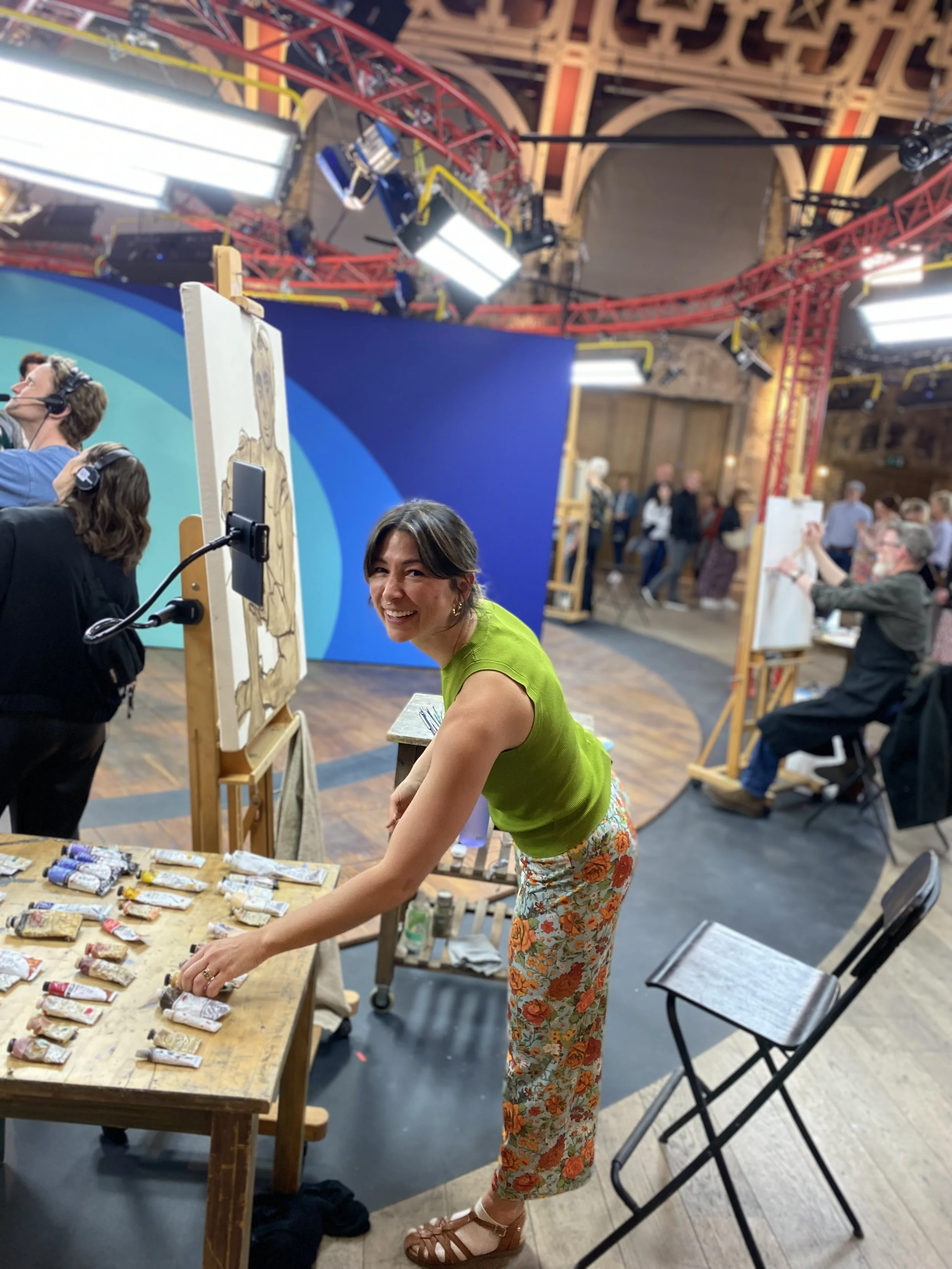
On set during the heats
How did it feel winning your heat?
Lauren: I was honestly surprised to progress past the first round! It wasn’t really until I was in the shortlist for my heat that I thought I might have a chance of going further in the competition. Another surprise was how competitive I became. I felt my confidence being galvanised when I progressed, making me want to be more ambitious with my work.
Chloe: I was buzzing and felt immensely proud of myself.
Courtney: Yes, I simply couldn’t even fathom that I might go any further than the first heats. It honestly just did not enter my mind.
What did you do to prepare yourself for the semi-finals?
Chloe: Changing formats from print to painted aluminium felt like a big risk, and although it paid off, I realised that I had a lot more I wanted to show and that I could push myself further for the next round (the semis). Between the heats and the semis, (just under two weeks), every spare moment was spent in the studio — testing out ink colours, mark-making, glazing, etc. My portrait of Clara Amfo was 60 x 80 cm, and as a simple way to push myself, I decided to work even bigger with a 70 x 100 cm panel. I’m used to making monotypes of this scale within a 7–8 hour period, so while it would be more of a challenge, I knew I wasn’t entirely out of my depth.
How was the semi-finals different to the heats?
Chloe: It felt a bit surreal returning to the set at Battersea Arts Centre. Yes, meeting all of the other semi-finalists was amazing — we shared experiences from our heats, and despite it being a competition, everyone was so positive and supportive of each other.
Lauren: The whole experience was even more fun than I expected. I loved meeting other artists and feeling inspired by the variety of styles, mediums and methods everyone used. Everyone in the crew was so incredibly caring and supportive too, so I really cherish my memories of Portrait Artist.
Katie: I actually felt calmer in the semis, as I knew what was to come in the sense of the order of the day, how it worked etc…what I needed to do and by what time, so as to be able to produce a painting that resembled an actual person. I was so not expecting to get through the first heat so I was just happy to make it to the semi-finals and just intrigued with who the celebrity sitter would be.
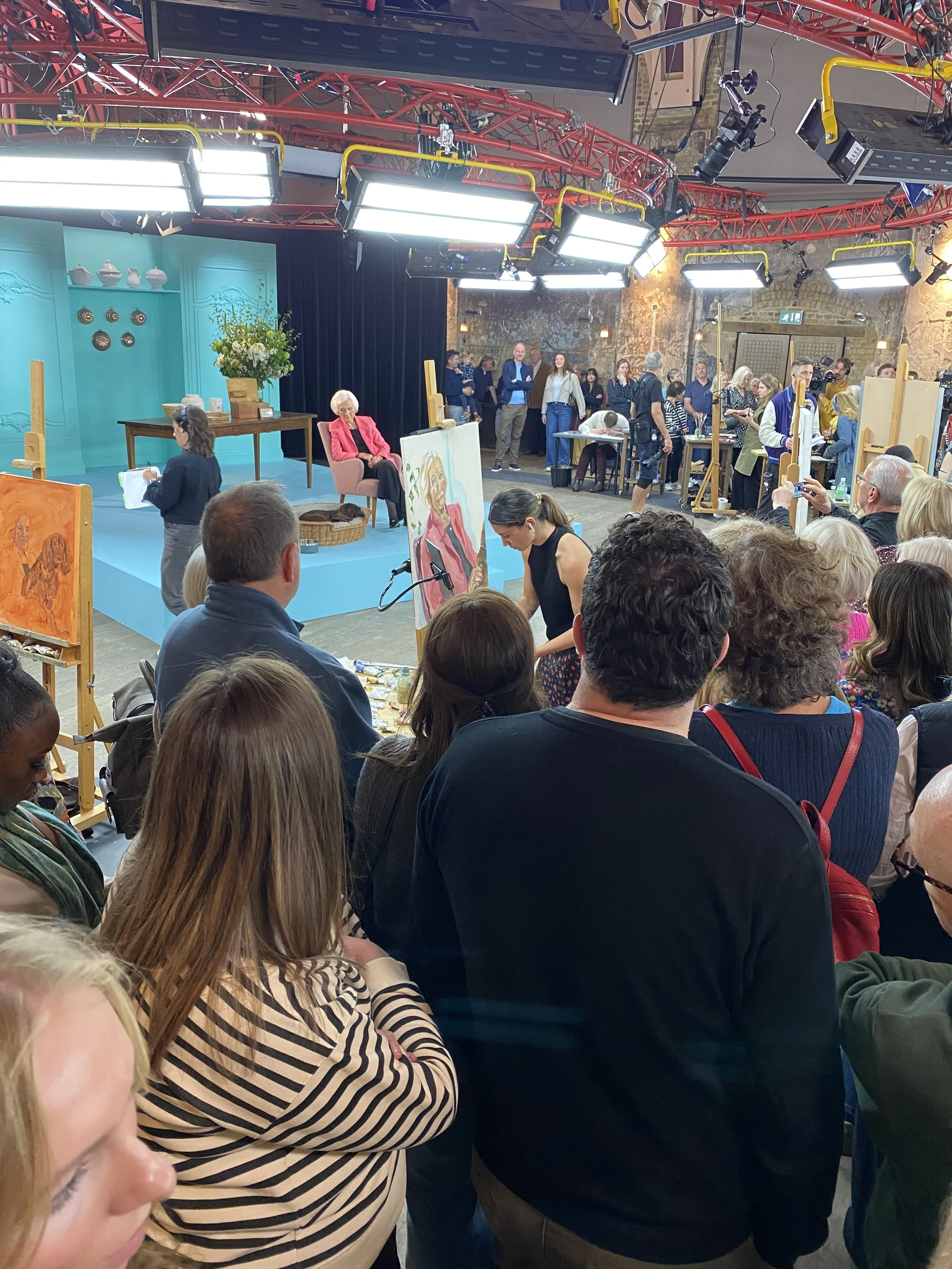
The audience onlooking at the Semi-finals
Courtney: I agree. It helped knowing where you would be, how your set up would work etc. Although I would say that the energy of the room changed a lot— it became much more intense.
What was it like having an audience?
Vincent: The audience in the semi-finals was seemingly quite different to the heats. Where previously they seemed rather jovial and genuinely interested in the work I was making, at the semi-finals they were problematic in that they would comment rather loudly on the work as it was being produced. In both cases they were generally respectful and kind with their feedback but at times they seemed too hungry to see the work as it was being developed.
It was unlike any situation I've ever worked in but I welcomed the unusual circumstances. I really enjoy critical feedback, I enjoy learning what the public’s mood is regarding fine art and am always eager and pleased with their comments, good or bad.
Lauren: I was actually quite easily able to deal with the pressures of painting with a crowd and judges looking on, since I find zoning into my own headspace comes quite naturally to me, especially with the help of my headphones.
What was it like entered in the set in the morning?
Chloe: When we entered the film set, the “cheese” was transformed into a single set filled with floral arrangements, English heritage décor, and cookware. To all of us artists, it felt entirely obvious that our sitter would be Mary Berry — so much so that the names of other famous British cooks completely escaped our minds when we were asked to guess! Sure enough, Mary walked onto the set, accompanied by her dog, Freddie.
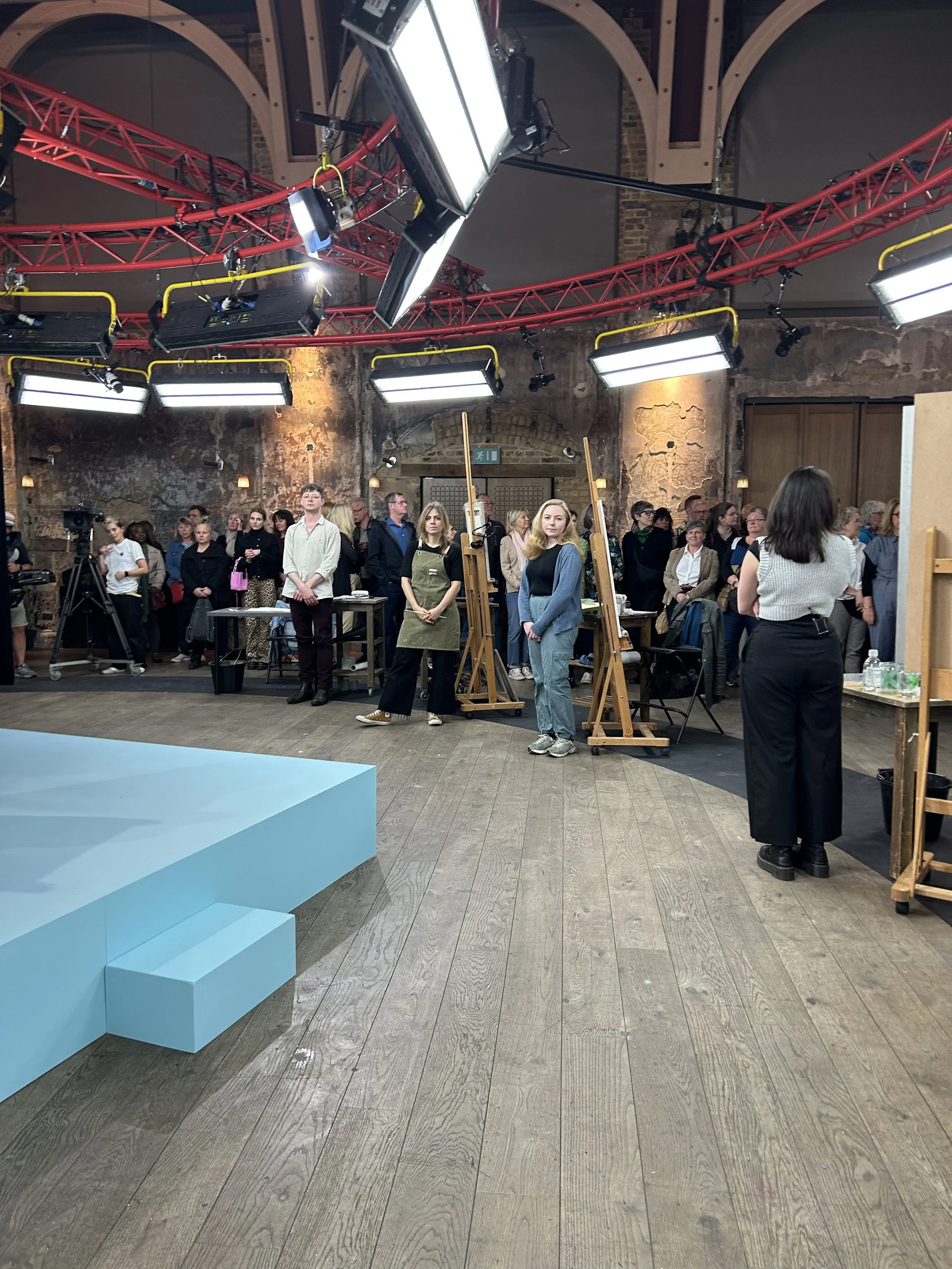
Vincent, Paulina, Lauren, and Chloe at the Semi-finals
What was the most terrifying part of the process?
Katie: The first hour, once they said…”artists you may begin!”. I was using the grid method on my board to draw the sitter and my hands were too shaky drawing it out that I had to have a word with myself! I am not a shaky person, so this threw me, but once I had taken a few deep breaths, talked myself down, I was able to crack on with it.
Definitely the first hour was the hardest, making sure I had a drawing and likeness I was happy with to then start painting. Once I started painting and put my earphones on I was a lot more into it. I have to say that talking to the camera about yourself was also pretty terrifying! I mean, in all honesty the whole day was terrifying and fascinating in equal measure. It’s all such a whirlwind.
Courtney: It was really tough having to make quick decisions rather than being able to be thoughtful and spend the time you need with the work and stepping way from it. I was really worried about that. It meant you had to really just go with your first gut reaction, which has its pros and cons.
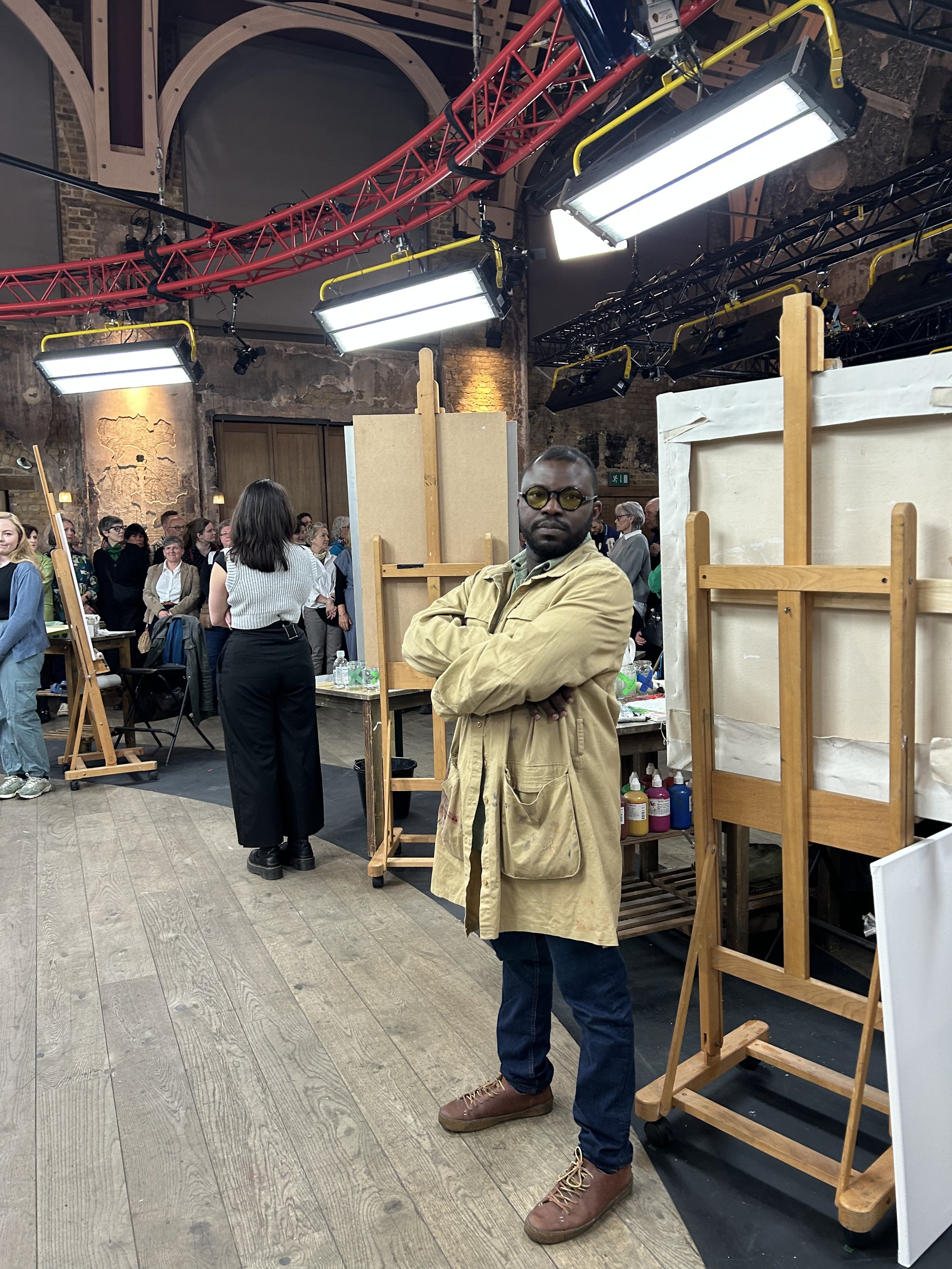
Chloe and Uthman during the Semi-finals
How was it working with the judges?
Uthman: It was a good way to ease the tension and their inputs were useful… and it wasn’t intimidating for me. The time spent during the heat was a great experience as I haven’t actually done life portrait in about 15 years!
Courtney: They were incredibly valuable. An artist rarely gets the chance to receive valuable and constructive feedback on their work. I found this to be one the most valuable takeaways from the show.
What was the biggest challenge for you?
Edie: I was really nervous going in as I didn’t have much experience painting live, it’s something I have always wanted to do more but haven’t really had the opportunity. I thought because of this it would come across that my process is less valid than others. For me the biggest challenge was getting through that mental block and trusting my process. I couldn’t have been more wrong because everyone was so kind on the show and it was really eye-opening seeing how differently everyone works.
Lauren: Whilst I was able to deal with the crowd and judges, the time pressure was trickier. Having to make quick decisions in the first ten minutes or so about the pose I wanted to capture, the still-life elements I wanted to incorporate and the colour scheme was a challenge. I suppose it was also a benefit, though, since it drove me to go with my gut and not overthink things. On the flip side, the ticking clock also made me abandon sense and logic at times and listen to my fears (aka. painting the face!). I find skin challenging to paint because you’re juggling texture, colour and value in every brushstroke, and for the style I wanted to employ, you have to achieve just the right amount of blending as well. It turned out alright in the end, but sustaining focus long enough to get both my heat and semi-final portraits to a (somewhat) finished point was definitely the hardest part of the competition.
Paulina: Time was an issue for me, I didn’t have the time to finish it properly. I know it’s just four hours, but there were still things I wanted to change — decisions I wasn’t too happy with (such as the choice of background colour). Had I had more time, I would definitely have reworked them.
Uthman: Actually, I tend to work very fast. The time limit wasn’t a challenge for me at all. I was trained with limited time to execute.
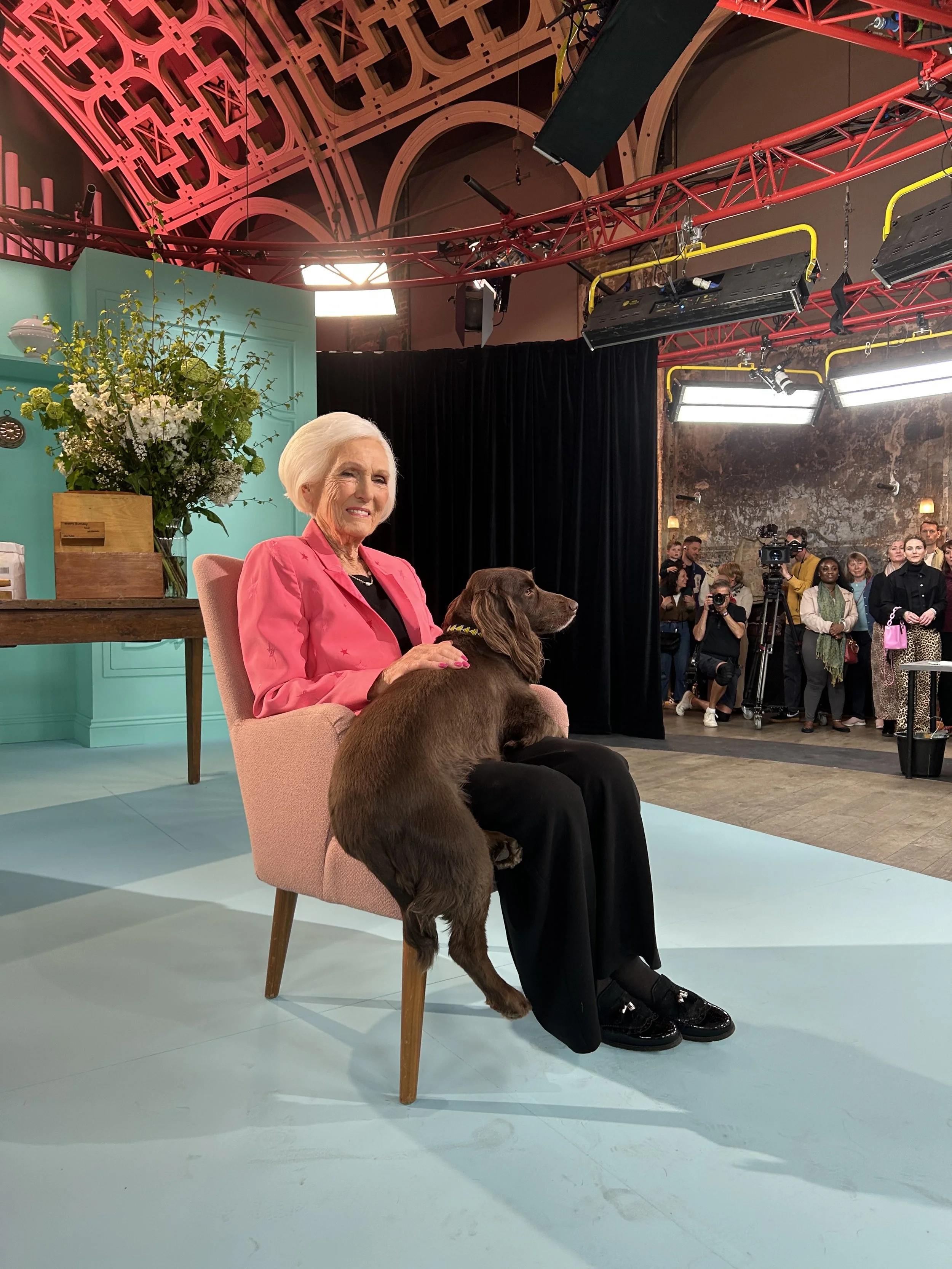
Dame Mary Berry on set
Courtney: Having a time limit means that there’s an added layer of pressure and mostly that inhibited my ability to be thoughtful at the level I would normally. Typically when I paint, I know who I’m painting well in advance and I’m considering this for quite some time. Then I’m thinking about how to stage them, what they should wear, how I’ll do the lighting and the background. I then have a chance to work with them in what feels a lot like an actual photoshoot and then finally I’m going away to crop and consider the compositions I have and how they will translate into the language of a painting. All of this happens well before I even begin to paint, so not being able to know who the sitter is, makes this all quite challenging.
It was also near impossible to position Mary Berry the way I had done with Reece, I didn’t even begin to think I could try. The other thing to consider is that unlike in the heats, this sitter cannot possibly be matched to everyone’s style when there are now eight artists to one sitter. This can also feel restrictive if you’re trying to get the best work out on the day. And then of course there’s the fact that Mary wanted the dog painted in the portrait.
Chloe: I’ve only painted a small handful of animals in my practice — including one other dog during a life drawing session. Going into my portrait, I planned to paint Freddie last, not out of apprehension, but because I’d learned the hard way that animals’ movements are unpredictable over a four-hour sitting.
Starting my painting, I ended up mixing two inks together: Prussian Blue and Viridian Green. Alone, the blue felt too cold, and the green lacked tonal depth on the aluminium. But together, they produced a teal that reflected the colour of the set and felt more appropriate for Mary. From watching previous PAOTY series, I knew that artists would be stationed further away from the sitter compared to the heats. I still hoped and planned to paint from life, but I knew it might be a challenge — especially with a dog in the mix. For the first couple of hours, I did work from life, but I really struggled to capture Mary’s likeness. What I didn’t anticipate was how Freddie would affect Mary’s movements — particularly her natural inclination to stroke him as he sat on her lap. Halfway through the day, I decided to take a photo and asked the assistant producer to print out two copies — one in colour and one in black and white. The photo I took of Mary was a lovely candid shot of her smiling off to the side, which really helped me to portray her warmth. She looked relaxed, unlike at the beginning of the sitting. Working monochromatically, I usually use black-and-white photos as references, mainly so I can easily identify tonal values and play with contrast — which was initially a challenge since Mary’s features are very soft and subtle.
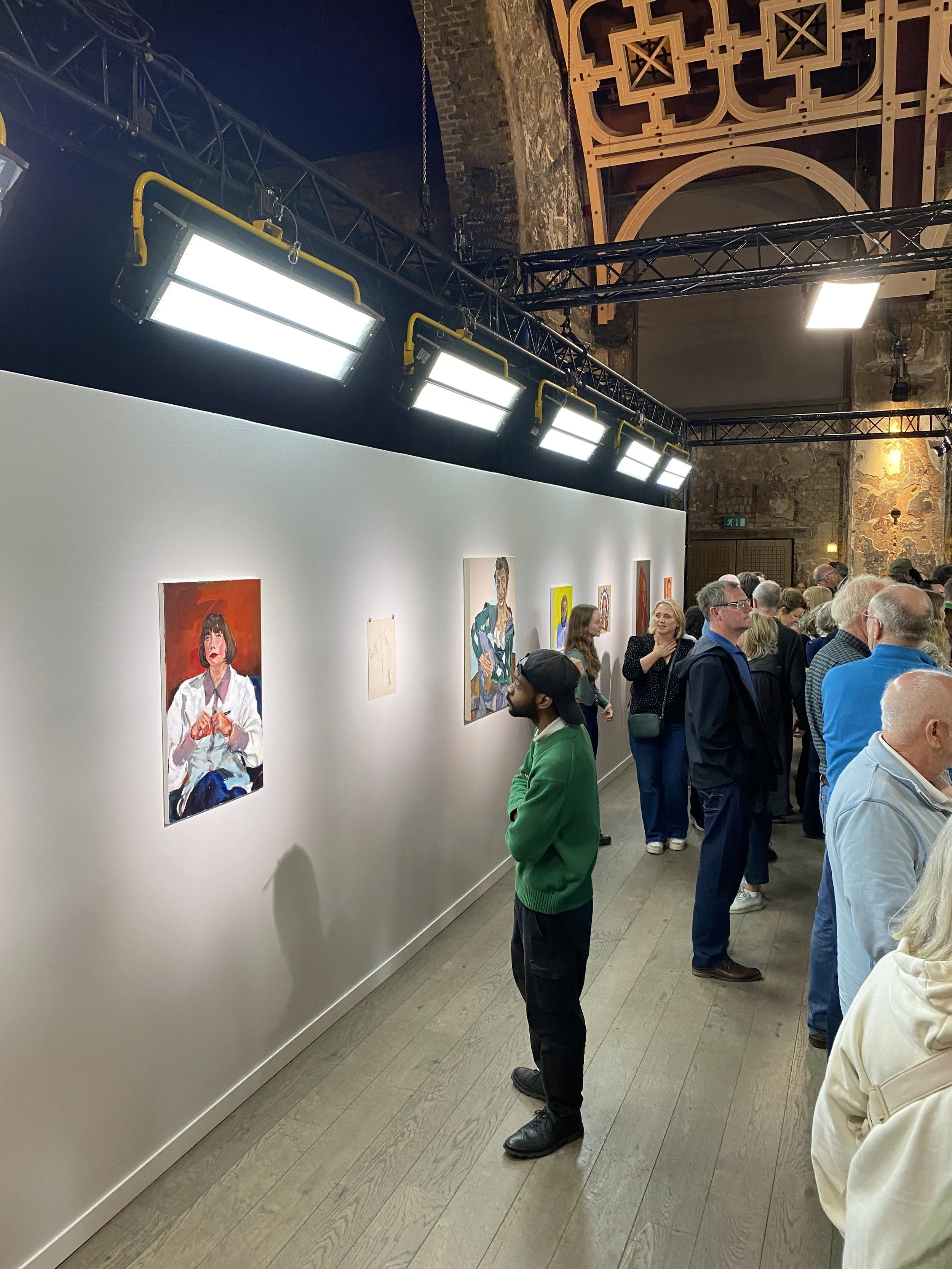
The Semi-finals wall on set
If you could go back and do it again, what might you do differently?
Edie: I would take more time on my Mary Berry painting, I was a lot less calm that day than the heat as there was so much more to paint and I was really shaky and rushed even taking my initial photos - I was so concerned with not inconveniencing the great Marry Berry that actually I think I could have gotten a better angle of her.
Paulina: I would definitely listen to my own gut. I was very stressed on the day (just like everybody else, I assume) and also very vulnerable. Mary Berry is a person with a lot of authority; she is much more mature and experienced than I am, and I felt a little overwhelmed by that. I had a great idea for her portrait but abandoned it the moment she mentioned she wanted Charlie, the dog, included.
It was a great lesson though too, I realised that when I feel connected to what I’m painting, and to the way I’m painting it, the results are incomparably better. I am hoping to paint the portrait I originally had in mind soon, just to make peace with the experience.
Vincent: If I could change one thing about the semi-finals I would change where I was stationed to complete the portrait. As I was looking at the sitter from the side I wasn't able to get a strong impression of their body language and general feelings mgs towards being a subject of study. Of course, i needed to go somewhere and I don't begrudge the situation too much. As I was working from a photograph it didn't impede on my work very much, but as a way of understanding the sitter I would have preferred a different location to work from.
I like to think I approached the challenge playfully and wasn't too concerned with the attitudes and opinions of the audience - a necessary evil in the worst case, and a charming addition in the best. There is little else I would have changed and nothing I didn't expect. Upstairs when reflecting that this was television, the event definitely did not disappoint. I had a blast. I would certainly do it again. Truthfully, there's nothing about it didn't enjoy. Happy days. Happy memories.
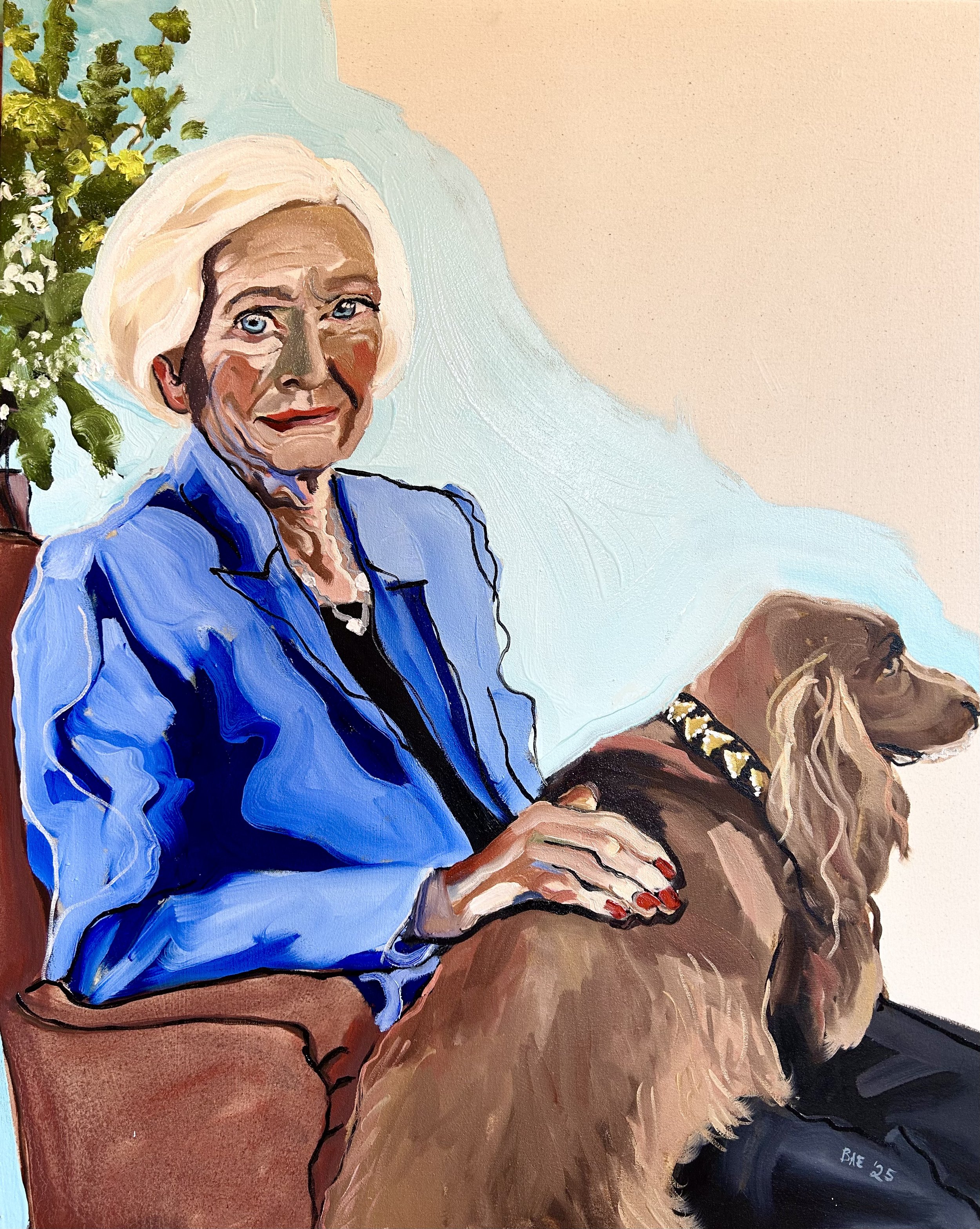
Courtney’s repainted portrait of Dame Mary Berry
Courtney: Like some of the other artists, I decided to repaint Dame Mary Berry at home after the Semi-finals. I wanted to see if I could make an amazing portrait out of her under different circumstances. I learnt two things, one is that my preferred colour palette usually doesn’t involve large amounts of pink, red, or orange. So by eliminating this on her blazer I was able to create something that felt more true to me. The second thing I learnt is that not being able to position the sitter the way I want to see them, holds me back from creating something I feel is compelling and so when I repainted her I still felt this was not quite right for me.
How has the show helped your practice moving forward?
Chloe: In the semi-finals, I definitely felt the pressure build up. Every artist around me was so talented in their own right, and it was really hard not to compare myself to them. Despite the anxiety, I felt proud of my ability to adapt my process for the competition — trusting my instincts and pushing myself to showcase more of my skillset as an artist.
By the fourth hour, things were really coming together, and I was able to add details to the floral vase in the background, the subtle patterns on Mary’s blazer, and her necklace. This round definitely felt more time-pressured, but I felt I’d managed to capture Mary’s softness and the warmth of her personality that I’d seen growing up watching Bake Off. When it came to the judging at the end of the day, I was blown away that Mary chose my painting to take home. I’d heard that she typically prefers more traditional forms of painting, which made it even more special that she connected with my piece.
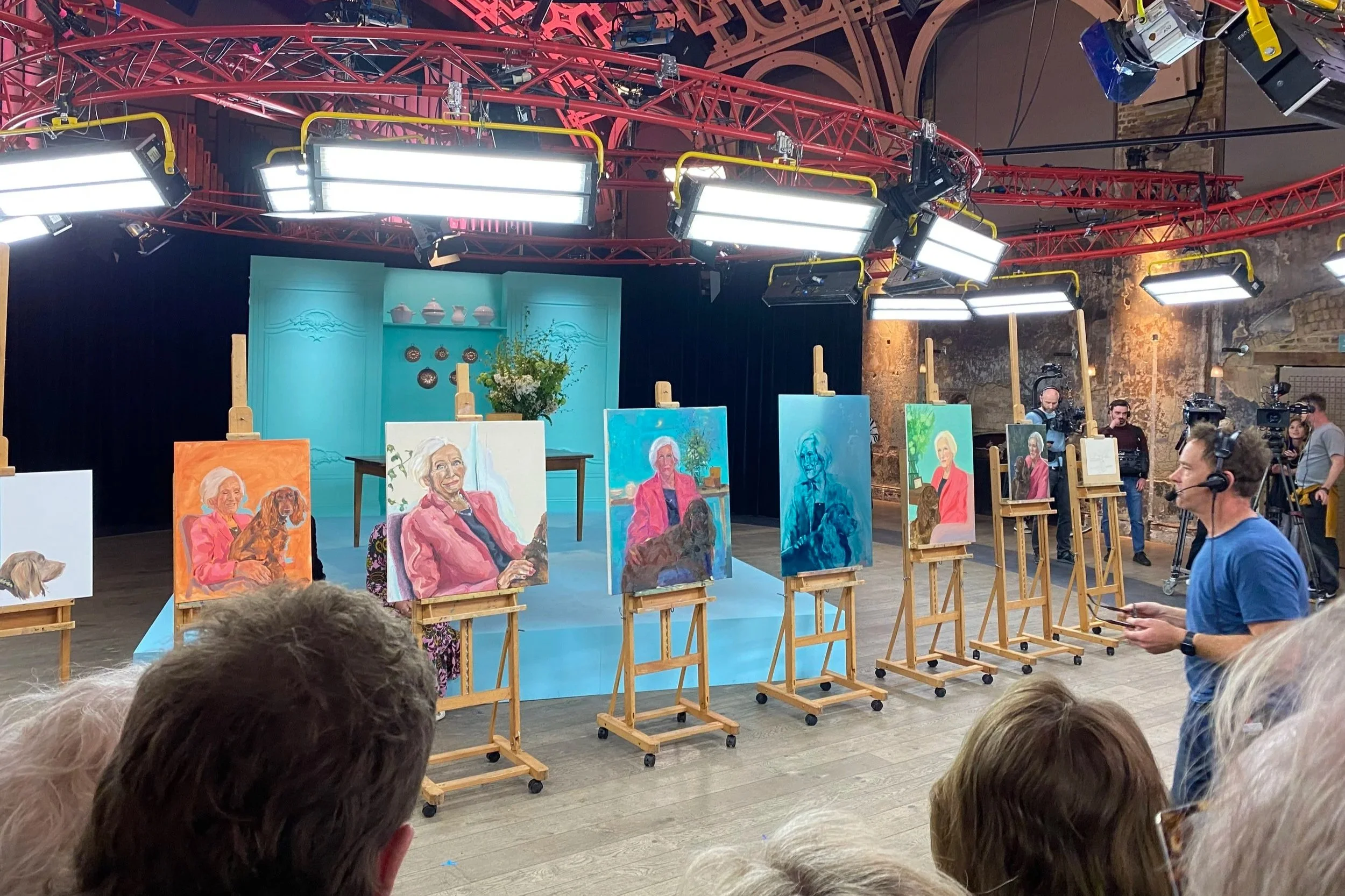
The final line up once time was up
Lauren: A nice surprise was how much I felt myself improving as an artist through the competition. It was like being at art bootcamp! My work really benefited from it, even though it was also one of the most challenging experiences I’ve ever had. I pushed myself to do my best possible work under the pressure, and although there are aspects of each painting I would have liked to develop, I’m happy overall with what I produced.
Paulina: It taught me to trust myself. After filming the show, I tried to focus more on my own work and accept fewer commissions — mainly those I truly wanted to paint. I realised I’m not a jack of all trades. The experience during the semi-finals was a little painful, but I believe it helped me a great deal in making better choices.
The entire experience of both the heat and the semi-final was incredibly motivating: the energy in the room was wonderful, the audience was lovely and supportive, and I felt deeply grateful for all of it. Painting is usually a solitary experience, but I was reminded once again of how it can bring people together, and being able to share that day with other painters meant a great deal.
Courtney: Something quite key for me was understanding the strengths within my work and my style. There was a lot of backlash about my work and there were many people being unkind on social media. This wasn’t particularly pleasant for any of us as no one’s ever really prepared for this when putting themselves out there! But one has to take the positive, have thick skin and lean into this as a good thing - the fact that my work can spark conversation is ultimately what I want. I’m not looking to create work that sits comfortably, I am looking to push people somewhere new. Realising my expressive style is a strength and that the more fluid and embracing I am of it, the better my work becomes. Like many artists, I am on a journey of really digging deep and staying true to my own unique identity so that it can come through in my work. Whilst I was in the semis I was learning a lot about myself and my work, as I am always doing and will always be doing. It is all a journey.
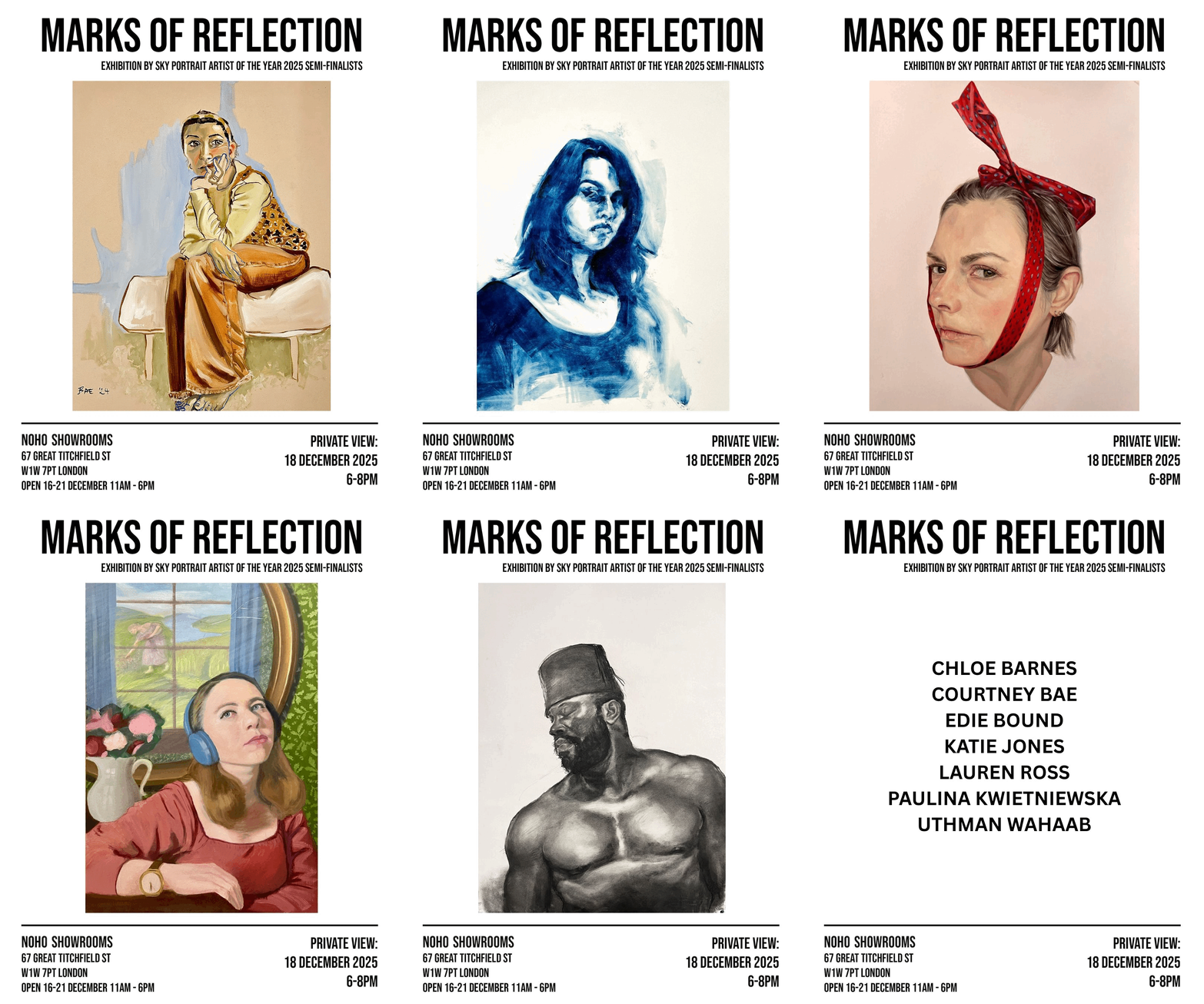
Marks of Reflection exhibition 16-21st December